The value of a price per tonne is only realized when the corresponding specification is clear. Two offers for 6 mm aluminum plate may differ in terms of the aluminum temper, thickness tolerance, required cutting, and/or delivery point. The difference in specification translates to a difference in cost at the time of the purchase order.
The factors that determine the price of an aluminum plate are outlined below. It’s best to first establish the required materials and then compare the totals for any given project. The purchase price may well omit work that the project still requires.
How does the metal market affect aluminium plate price?
The price of the metal will move with the Aluminium market, but the Conversion Charges have their own individual calculations based on rolling, treatment, finishing and handling. Therefore, the percentage change in metal price does not necessarily translate to the same percentage change in the finished plate price.
The pricing date is important when offers are published several days apart.
Which pricing date applies to the order?
Verify if the supplier fixes the metal price when quoting, accepting the order, receiving payment, or dispatching the goods. Different exposures to market fluctuations are possible. The validity period of the quotation must clearly state the applicable arrangement.
Is the conversion charge included?
Some offers for base metals quote metal and conversion separately, while others quote a combined price. A single price is meaningless unless it is stated in what currency, including all taxes, and what the delivery terms are.
Why do alloy and temper change aluminium alloy plate price?
The alloy designation describes the composition of the alloy, and the temper describes the condition in which the material is supplied. Both the alloy and temper determine the production route and the properties of the material that will be supplied to the buyer.
When bending plates, elongation and bend requirements can be more important than the highest strength available. A machined part is a different story. Changing to a less expensive alloy or temper without verifying the application can have significant effects on fabrication.
The price for aluminum alloy plates is influenced by production methods as well as current stock and order quantity. Heat treatment may need to be added for certain alloys, but the numbers of the alloys themselves do not create a generally applicable price ranking.
We recommend that the alloy and temper are specified on the enquiry. Drawings and fabrication details will help to clarify any uncertainty prior to a price being issued. The aluminium alloy selection guide can be used as a starting point for discussion.
What does aluminium plate thickness price actually measure?
Thickness changes weight per piece but does not affect price per kilogram.
For example, a plate of 1,000 x 2,000 mm with a theoretical height of 6 mm and an approximate aluminium density of 2,700 kg/m³ has a theoretical weight of 32.4 kg. A 12 mm plate of the same dimensions would weigh approx. 64.8 kg. Note: this is an estimate dependent on alloy density and exact dimensions.
When reviewing aluminium plate thickness price, the theoretical increase in weight of a plate is roughly doubled when thickness is doubled, but the conversion charge is not necessarily doubled. The production route, quality control, stock holding, etc. can all vary.
The tolerance should be listed on a separate line. A requirement for a nominal 6 mm part with a large permissible deviation is very different from a requirement for a nominal 6 mm part with very close minimum thickness. Verify that invoicing is done on actual weight, theoretical weight, or stipulated weight per part.
When do custom dimensions increase the cost?
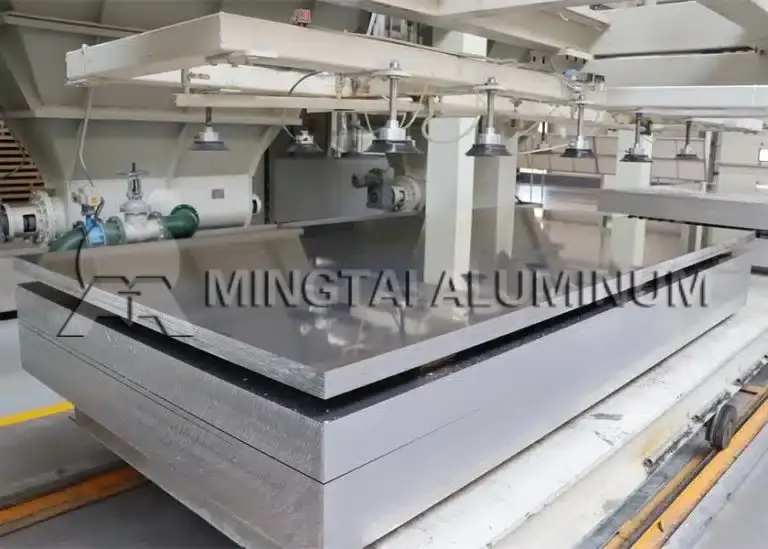
A finished blank and a mill-size plate are different purchasing requirements, even when they use the same alloy.
Suppose a workshop needs twenty identical rectangular blanks. Instead of buying larger plates to reduce material costs, the cutting, checking, and allowing for waste of the blanks would be included in the supplier’s quotation for finished blanks.
Neither choice is cheaper by default. The cost of each option will depend on the cutting yield as well as the potential value of the remaining material.
When purchasing, width, length, squareness, and edge quality must all be specified. Very tight dimensions may require a special cut or even subsequent inspection. Check with the supplier what operation is covered by the custom-size surcharge and whether a different stock size would yield more.
How much can bulk aluminium plate price save?
The spreading of setup and handling costs over more material can make a lower price for bulk aluminum plates plausible. The saving in price, however, will depend on the consistency of the order.
One specification of 10 tons is likely easier to schedule than 10 tons of different alloys, tempers, and sizes. Just looking at total tonnage does not tell the whole story.
Negotiate quantity breaks off an unchanged specification and compare the resulting savings to storage costs, available cash, and the project’s consumption profile over time. The value of a discount is often short-lived and far less than the value of unused plate stock.
For repeat business, also discuss the frequency of deliveries and the total amount of articles you will purchase. A production plan is easy to discuss, but the commercial conditions need to be agreed upon.
What belongs in aluminium plate processing cost?
Charging for processing is easier to understand when linked to actual transactions. Extra processing is an obscure term that does not account for a large price difference.
Which fabrication operations are included?
Different processes require different types of machinery and time. Additional materials and time for application of protective film.
The relevant comparison for aluminium plate processing cost is the amount of work required after delivery to the factory. Suppliers cutting blanks to order may save time in the factory, but a premium may be charged which is greater than what the factory could cut it for. This comparison should be made with reference to the quantity required and expected yield.
Which inspection documents are required?
A mill certificate, a dimensional report, and third-party inspection all serve different purposes. Confirm which documents will be supplied with your shipment and which will incur a separate charge.
Quality and Inspection guidance will aid in framing the enquiry. Acceptance will be against the agreed standard incorporating traceability and against measured characteristics detailed in the purchase specification.
How do packing and delivery change the amount payable?
A freight quotation must contain a destination. “Delivered” is not good enough – it needs to be a specific location.
Packing also needs to be suitable for handling and protection. Bundles will often require support and restraint, and exposed edges can need to be guarded. Protection from moisture is also required where materials could suffer from water staining in storage or during transport. The labels need to connect the material to the relevant alloy, temper, dimensions, quantity and lot.
Is packing included in your requirements, and will it facilitate unloading at destination? Our packaging guidance is relevant here.
When requesting a quote from an aluminium plate supplier, make sure that the supplier quotes any additional costs such as freight, insurance, duties, etc. that are outside of your agreed delivery terms. Compare the total amount you will be charged for the same scope of work, excluding any exceptions, with a price from MINGTAI ALUMINUM.
FAQ
Q: What affects aluminium plate price most?
A. Metal value is a major factor. The Alloy, Temper, Dimensions, Processing, quantity, and Delivery terms explain most of the remaining variation between offers. The largest difference between two offers may be due to an unlisted service rather than the metal itself.
Q: How do I compare aluminium plate price per kg with a price per piece?
A: Divide the price for the piece by the weight of the piece as stated. Find out if this is the actual weight or the theoretical weight, and if the price includes cutting, packing, and/or freight.
Q: Why is aluminium plate thickness price not proportional to thickness?
A: Weight changes with thickness more or less than weight at fixed width and length. The costs of production and control can deviate from these requirements and need not be passed on in the same proportion in the end product.
Q: What should I check first in an aluminium plate supplier quotation?
A: First agree alloy, temper, dimensions, and tolerances. Then compare weight basis, any additional operations, documents, delivery terms, and validity date.