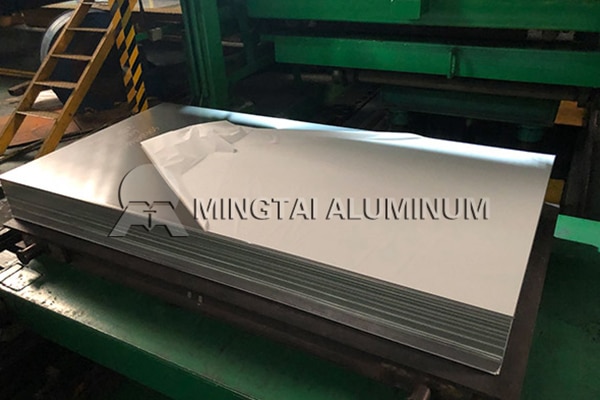
The number 16 does not tell a fabricator enough about an aluminum sheet. It has to be converted first: 16-gauge aluminum sheet is nominally 0.0508 inches thick, or 1.29 mm. A quotation may round that to 0.051 inch or 1.3 mm. For a price estimate, the rounded figure is normally adequate. A production drawing needs the decimal thickness and tolerance.
The more important decision is how the blank will be formed, i.e., will it be drawn into a deep drawing shape, formed into a cabinet part and left outside, or machined into a bracket? The formed part will be of a different alloy than the original sheet, even if all were offered as sheet, i.e., 1100, 3003, 5052, and 6061.
How Thick Is 16 Gauge Aluminum?
The nominal thickness of a sheet of aluminum 16 gauge is 0.0508 inches. Multiply by 25.4 to get 1.29032 mm, or 1.29 mm as it is normally written. This is how thick 16-gauge aluminum sheet is.
The actual thickness of a sheet is not likely to be an exact 0.0508-inch measurement. The permitted variation due to rolling tolerances is specified within a certain range based on alloy, temper, width, etc., as defined in the appropriate order standard. This does not usually present a problem for simple sign faces but can become important when constructing folded housing parts. Thickness affects the bend allowance and affects the positioning of mating edges.
A broad panel can feel less rigid than its gauge would suggest. Additional stiffness is provided by folded returns, beads, or ribs in the panel. The amount of flex in a panel is not always provided by increasing the gauge of the material, and it may be worth establishing whether the design of the panel is not providing the amount of flex required.
What Does 16 Gauge Aluminum Thickness in mm Mean for a Drawing?
For 16 gauge aluminum, the nominal thickness is 1.29 mm. In stock lists of aluminum sheets, it is common to find also 1.2 mm and 1.3 mm. These are not three names for the same item, but rather three articles of different thicknesses. A 1.2 mm thick sheet is approximately 7% thinner than a 1.29 mm thick sheet.
The difference between the two could be more than just weight. It could change the position of the neutral axis for a bend, change the developed blank size, and possibly even affect the fit of screws or other clips. The difference could be acceptable for a loose cover, but could be a matter for review for a stamped enclosure with return flanges, for example.
Why Is Metal Thickness Gauge Easy to Misread?
A metal thickness gauge is not read like millimeters. Actually, the gauge number runs in reverse order, i.e., the lower number indicates the thicker material. There are conversion tables for every material. Therefore, 16-gauge mild steel does not equal 16-gauge aluminum.
Reference an aluminum sheet gauge chart to put decimal thicknesses on your inquiry. This will keep a possible steel conversion from being ordered as aluminum.
How Does the Part Point to the Right Alloy?
First, identify the greatest demand on the material for a particular operation. If that involves the metal going through a deep draw, then formability will be the main criterion. However, if it’s left sitting by the saltwater, then corrosion resistance will take over. A machined mounting face provides additional strength and also good machinability.
1100 for a Deep or Repeated Draw
1100 is an industrially pure aluminum product with high elongation and good formability, with corrosion resistance and useful electrical and thermal conductivity. Its low strength, however, means that 1100 cannot be heat treated to form a high-strength structural grade aluminum product.
The limits for 1100 shown here will be useful for assessment of parts. Parts such as utensils, heat sinks, bottle caps, printing plates, heat-exchanger parts and other decorative products can be considered. For example, a deep-drawn cover would be suitable for use with 1100; a flat guard intended to take repeated impacts would not.
3003 for Familiar Sheet-Metal Work
For cabinet skins, ventilation parts, tank walls, and similar applications, 3003 aluminum offers a middle ground of strength, formability, weldability, and corrosion resistance, given by the presence of manganese that makes it stronger than 1xxx series aluminum.
Production uses include pressure vessels, storage equipment, battery casings, cooling plates, tanks, and cabinets. Picture a panel with punched louvers followed by two long bends. It needs predictable forming, not the highest available strength. Here, 3003 may be easier to run than a harder grade. Temper still changes its behavior; H14 stock will not bend exactly like annealed material. The page on 3003 aluminum sheet for roofing and cladding shows how the alloy is used in formed products exposed to weather.
5052: Where Moisture and Vibration Meet
Electrical housings, vehicle panels, fuel tanks, and marine components are examples of products made from sheet. 5052 provides weldability, formability, medium static strength, high fatigue strength, and good corrosion resistance. 5052 is an Al-Mg alloy that is strengthened by cold working as opposed to heat treatment.
5052-H32 would be a better choice than 1100 or 3003 for a roadside enclosure that gets exposed to rain and vibrates. The material is formable but is not soft sheet aluminum. Check the bend details, particularly for a tight inside radius, to see if they will crack when bent across an unfavorable grain direction. Available specifications for 5052 aluminum sheet are listed on the 5052 aluminum sheet page.
6061: When the Part Will Be Machined
This ‘sheet-metal’ part needs to have bored holes, milled faces, and sufficient stiffness to act as a mounting bracket. Hence 6061/T6 could be considered. This alloy is heat-treatable and is noted for its corrosion resistance, weldability, machinability, and good response to anodizing.
6061- T6 and 6061- T651 are the typical grades used for frames, base plates, couplers, valves, brackets, etc. They have sufficient strength but are not designed for tight bending. Therefore, if a drawing contains a number of small-radius bends, 3003 or 5052 would likely be a better material to make the part from. The same fabrication considerations are compared for 5052, 6061, and 3003 in this aluminum sheet selection guide.
What Should Appear on a 16 Gauge Aluminum Sheet Metal Inquiry?
Do not stop at “16 gauge aluminum.” State the alloy, temper, decimal thickness, tolerance, sheet size, quantity, surface finish, and protective-film requirement. Note what happens next—punching, bending, welding, machining, or anodizing—and describe the service environment.
We make sure to note details that could make two very similar-looking orders look different. For example, an indoor 3003 cover with wide-radius bends is a very different material choice than a 5052-H32 enclosure that could be sitting on the side of a road. Both are made with 16-gauge aluminum sheet metal.
MINGTAI ALUMINUM supplies 1100, 3003, 5052, and 6061 aluminum sheet in multiple tempers and dimensions. We recommend sending the drawing with the inquiry and marking critical bends, visible faces, and fitted dimensions. Our team can then review the material as part of the finished component rather than quoting a gauge in isolation.
FAQ
Q: How thick is 16 gauge aluminum sheet?
A: 16 Gauge Aluminum Sheet is typically .0508” / 1.29 mm thick. Material supplied would need to fall within the specified tolerance.
Q: Is 16 gauge aluminum sheet metal suitable for an enclosure?
A: Yes, it can be. In our experience, 16 gauge aluminum sheet metal is not necessarily rigid. The rigidity of the material depends on a number of factors, including the span of the panel, the folded edges, additional reinforcement, the alloy, the temper, and the load placed on the material. 5052-H32 aluminum is frequently specified where there is exposure to moisture and/or vibration.
Q: Which alloy suits 16 gauge aluminum sheet thickness?
A: For 16 gauge aluminum sheet thickness, the following might be considered. 1100 aluminum sheet for deep drawing, 3003 aluminum sheet for general uses of aluminum sheet, 5052 aluminum sheet for corrosion-resistant formed parts, 6061 aluminum sheet for machined parts or structural parts.
Q: Is 16 gauge aluminum thickness in mm exactly 1.3 mm?
A: 16 gauge aluminum is nominally 1.29 mm thick. A description of 1.3 mm thickness is a rounded number, and for precision orders, it is better to specify the required decimal thickness and tolerance.