6061 aluminum is one of the most widely specified heat-treatable alloys for structural engineering, CNC machining, and industrial fabrication. Its combination of medium-to-high strength, good weldability, and reliable corrosion resistance makes it a standard choice for global distributors, machine shops, and OEM contractors.
However, specifying "6061" alone is rarely enough for mill-direct procurement. Selecting the wrong temper—such as ordering standard T6 instead of stress-relieved T651 for heavy CNC milling—can lead to part warpage, scrap, and project delays.
This guide covers the chemical composition, temper differences (O, T4, T6, T651), machining behavior, and key parameters to confirm when sourcing 6061 plate and sheet directly from a rolling mill.

Chemical Composition & International Standards
6061 belongs to the 6xxx series (Al-Mg-Si), using magnesium and silicon to form magnesium silicide for precipitation hardening. Mill-supplied 6061 sheet and plate are typically produced to ASTM B209 (or EN 485 / GB/T 3880 upon request).
6061 Tempers Compared: O, T4, T6, and T651
Because 6061 is heat-treatable, its mechanical properties and formability change significantly depending on thermal and mechanical processing.
Note: Exact minimum mechanical values in ASTM B209 vary by product thickness. The table below provides typical reference ranges for engineering comparison.
- 6061-O: Annealed (softest state) ; Deep drawing, severe bending, complex forming ;
- 6061-T4: Solution heat-treated & naturally aged ; Moderate forming/bending before final aging ;
- 6061-T6: Solution heat-treated & artificially aged | Structural brackets, general fabrication, light machining ;
- 6061-T651: T6 + stress-relieved by controlled stretching ; Heavy CNC milling, precision tooling, mold bases, aerospace/semiconductor fixtures.
6061-T6 vs. 6061-T651: Which One for CNC Machining?
While both share similar mechanical properties, 6061-T651 is stress-relieved by controlled stretching (1.5% to 3% permanent set) after solution heat treatment.
- Why it matters: Standard T6 plate contains residual thermal stress from quenching. During heavy CNC milling or wire EDM, residual stress releases, leading to warpage and dimensional instability.
- Recommendation: For precision machined blocks, mold plates, and semiconductor tooling, always specify 6061-T651. For structural brackets, stamping, or bent parts, standard 6061-T6 or T4 is cost-effective.
(Note on thickness: Controlled stretching to T651 is generally applied to plate thicknesses—typically 6.35 mm / 0.250" and above under ASTM B209—whereas thinner sheet products are normally supplied in O, T4, or T6 tempers.)
Mill-Direct Procurement Checklist: How to Specify 6061 for an Accurate Quote
When requesting a quote from a primary rolling mill rather than a local metal service center, providing complete technical specifications upfront avoids back-and-forth revisions and speeds up production scheduling.
- Alloy & Temper: Clearly state whether you need 6061-T6, 6061-T651, 6061-T4, or 6061-O. Do not leave the temper blank if the material is going into a CNC shop.
- Dimensions & Tolerances: Specify thickness, width, and length (in mm or inches). Standard export sheet and plate sizes (such as 1220 × 2440 mm / 4' × 8', 1250 × 2500 mm, or 1500 × 3000 mm) are easier to combine into mill runs, while custom dimensions may require higher minimum order quantities (MOQ).
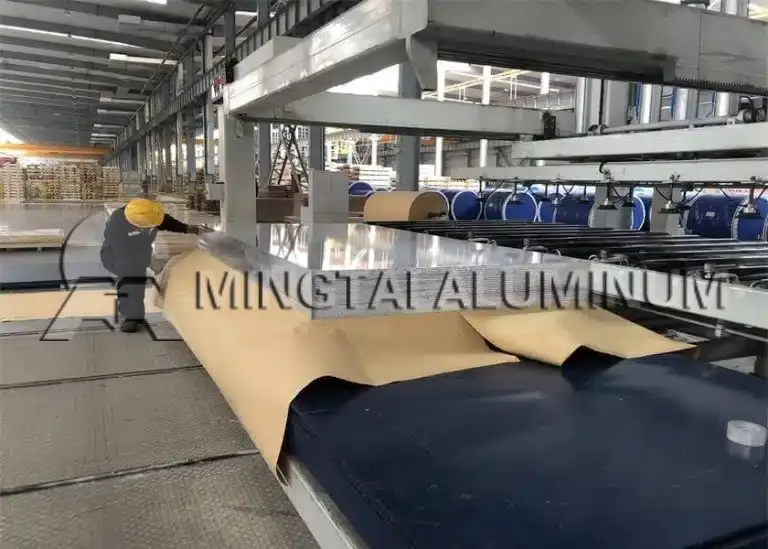
- Surface & Protection: Indicate if you need mill finish or single/double-sided PE protective film to prevent scratching during transit and laser cutting. we have Double Blue 80/2-BLUE or Paper Jam PI and other.
- Order Volume & Destination Port: Mill-direct production runs are scheduled by weight (metric tons) per specification. Providing your target tonnage and destination port allows the mill to quote accurate FOB, CIF, or CFR pricing. Our MOQ is 8 tons each size.

FAQ
Q1: Can 6061 aluminum sheet be bent without cracking?
A:In the T6 temper, 6061 has low elongation (~8–10%) and will likely crack if bent to tight radii. If severe cold forming or 90° bending is required, use 6061-O (annealed) or form it in T4 condition, followed by artificial aging to T6.
Q2: Does 6061-T6 have good corrosion resistance in marine environments?
A: 6061-T6 offers good atmospheric corrosion resistance. However, for continuous seawater immersion or harsh marine splash zones, 5083-H116/H321 or 5052 are superior due to their copper-free composition.
Q3: What is the typical MOQ when buying 6061 plate directly from an aluminum mill?
A:Unlike local distributors that sell single cut pieces, aluminum rolling mills schedule production by rolling lot and heat-treatment batch. Mill-direct MOQs are typically measured in metric tons per thickness and temper (unless matching ready stock is available in full-pallet bundles). Sharing your required sizes and total weight upfront helps the mill confirm whether your order fits a standard production run or existing inventory.
Request a Mill-Direct Quote for 6061 Aluminum Sheet & Plate
Looking for reliable 6061-T6 or 6061-T651 supply for your distribution warehouse or machining operations? Send us your temper, dimensions (thickness × width × length), quantity (tons or sheets), and destination port. Our technical sales team will review production feasibility and get back to you with a mill-direct quotation and lead time.
You can contact us.or send Email:sales01@mingtai-al.com