1. Introduction: Why 5×10 Aluminum Sheets Matter Today
Aluminum sheets show up in more places than most people notice—machine shops, trailer factories, building facades, road sign workshops, the list goes on. And among all the sheet sizes out there, the 5×10 format (60 × 120 inches) is the one buyers often call “the big, convenient one.”
Why? It covers a wide surface in one go. Fewer seams, fewer alignment headaches, and fewer questions from installers asking “Do we need another joint here?”
Typical alloys like 3003, 5052, and 6061 are always available in this size. Each has its personality: 3003 bends nicely and has that semi-shiny look people like for tanks or trailer roofs; 5052 is the “marine-safe” choice with magnesium as the main alloying element; 6061 is the tougher, heat-treatable option that machinists love but fabricators sometimes curse because it doesn’t like tight bends.
This guide walks through weight, pricing, and where these sheets actually get used in real industrial settings.
2. What Is a 5×10 Aluminum Sheet?
2.1 Dimensions and Standard Thickness Options
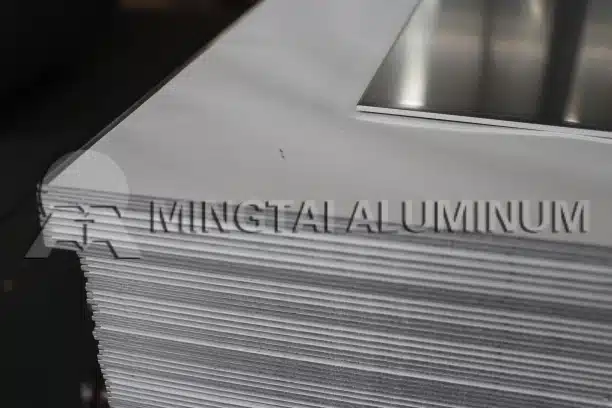
A 5×10 aluminum sheet measures 5 ft × 10 ft (around 1.52 m × 3.05 m).
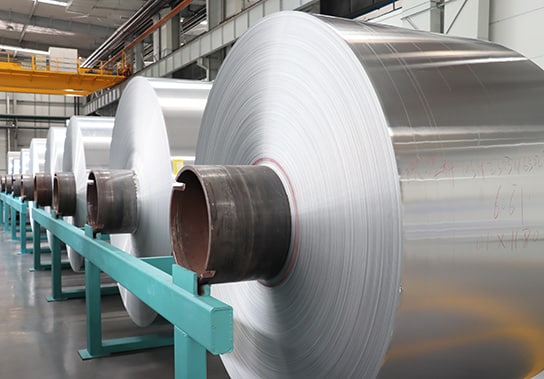
Manufacturers roll them in many thicknesses, from thin 0.032" sheets used in signage to heavy 0.25" plates that feel almost like a panel from a small boat hull. Some mills can even roll very thick custom plates—up to several hundred millimeters—though those usually need a special order and long lead times.
You’ll see tempers like H14, H32, and T6. In real shops, fabricators just say things like “Don’t bend the T6 too tight or it will crack,” which sums up the differences pretty well.
2.2 Key Material Characteristics
Aluminum stays light but surprisingly strong. Even large 5×10 sheets can be moved by two people if the gauge isn’t too thick. Corrosion resistance is another practical benefit—especially for 5052 and 5000-series alloys that hold up in salty coastal environments.
6061 aluminum sheet, while strong and weldable, behaves differently when forming. Anyone who has tried to force a sharp bend in 6061-T6 knows the little “pop” that means the material wasn’t happy.
3. Weight of a 5×10 Aluminum Sheet
3.1 How Weight Is Calculated
Weight depends on thickness and alloy density. The simple formula goes like this:
Weight = Area × Thickness × Density
- Area = 60" × 120" = 7,200 in² (50 ft²)
- Density ≈ 0.097 lb/in³ for most aluminum alloys
Small variations come from alloy differences and rolling tolerances. Some old-school fabricators still keep a hand-written chart pinned to the wall.
3.2 Weight Table for Popular Thicknesses
Approximate weights for a 5×10 sheet:
| Thickness (inches) | Approx. Weight (lbs) |
|---|---|
| 0.040 | ~27 |
| 0.063 | ~42 |
| 0.080 | ~53 |
| 0.100 | ~66 |
| 0.125 | ~83 |
| 0.190 | ~126 |
| 0.250 | ~165 |
These numbers match what most distributors quote when customers ask “Can I move this alone or do I need help?”
3.3 Why Weight Matters
Weight affects everything:
– freight charges
– how many sheets one worker can handle
– structural design calculations
– total load on trucks, trailers, or façades
In projects like trailer manufacturing, choosing 0.080" instead of 0.063" can add 10–15 pounds per sheet, which doesn’t sound like much until you multiply it across dozens of panels.
4. Price of 5×10 Aluminum Sheets
4.1 Typical Price Range (per sheet & per square foot)
Prices shift with market aluminum ingot costs, but the ranges usually fall here:
- Thin sheets (0.040"): ~USD 120–180 per sheet
- Medium sheets (0.080"–0.125"): ~USD 200–400
- Thicker plates (up to 0.25"): often higher depending on alloy
Price per square foot lands somewhere between $2 and $8, more if anodized or polished.
4.2 What Affects the Price?
Several small things matter more than people expect:
- Alloy: 6061-T6 costs more than soft 3003.
- Thickness: obvious but important.
- Surface treatment: anodizing, powder coating, filming.
- Order quantity: buying 200 sheets lowers the unit cost dramatically.
- Processing services: CNC cutting or bending adds to the final invoice.
For something special, like 6005 sheets used in train components, prices depend entirely on the customer’s technical drawing and order plan.
4.3 Cost Comparison: 5×10 vs. 4×8 vs. 5×12
A 5×10 covers 20 extra square feet compared to a 4×8 sheet.
The catch?
Shipping 5×10 sheets sometimes requires a custom pallet, which carriers love to charge extra for.
5. Strength & Performance Characteristics
5.1 Mechanical Strength by Alloy
A few real-world numbers:
- 3003 → softer, ~20 ksi tensile strength; easy for tanks, panels, and shaping
- 5052 → ~33 ksi; famous for corrosion resistance and marine use
- 6061-T6 → up to ~45 ksi; used in structural brackets, frames, and platforms
5.2 Environmental Durability
Alloys like 5052 and 5005 stay stable even in salty air.
This is why cladding companies in coastal cities often switch to 5005—its color consistency after anodizing looks more uniform.
5.3 Suitable Finishing Options
Common finishes include:
- anodized
- brushed
- powder coated
- mirror polished
- protective plastic film for shipping
Each finish changes both the look and the price.
6. Popular Industrial Uses for 5×10 Aluminum Sheets
6.1 Construction & Architecture
Because of the large surface area, architects use 5×10 sheets for:
- cladding panels
- decorative trims
- exterior wall systems
- fascia and canopy surfaces
5005 aluminum alloy is especially common in luxury building façades.
6.2 Manufacturing & Fabrication
Large sheets help reduce scrap in:
- machine guards and covers
- fabricated enclosures
- conveyor surfaces
- tooling plates
Some shops prefer 5052 or 6061 depending on how much bending is involved.
6.3 Automotive & Transportation
Used for:
- trailer siding
- RV exterior skins
- toolboxes
- truck beds
3003 sheet is popular for trailer roofing because it bends gently and doesn’t crack.
6.4 Signage & Advertising
Big signs need big sheets:
- billboards
- traffic signs
- branding displays
3105 aluminum sheet is also common here thanks to its good paint adhesion.
6.5 Marine & Outdoor Equipment
Marine-grade alloys handle saltwater:
- dock plates
- boat interior panels
- equipment housings
For more specialized applications, 5059 appears in LNG tanks and ship structures.
7. Installation & Fabrication Notes
7.1 Cutting, Bending, and Forming
Fabricators usually pick between:
- CNC routers
- hydraulic shears
- plasma cutters
The bending radius varies. H14 bends tight; 6061-T6 prefers a gentle touch.
7.2 Mounting & Joining
Welding performance differs:
- 5052 → welds very cleanly
- 6061 → weldable, but heat changes the temper, so joints may need re-aging
Rivets and structural adhesives are common alternatives.
7.3 Handling & Storage
To avoid headaches:
- keep the protective film on
- don’t drag sheets on concrete
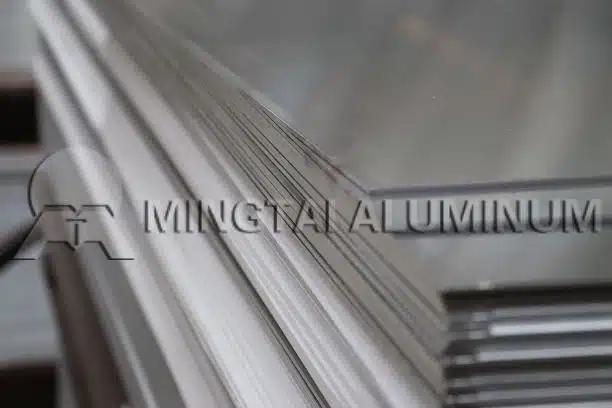
- store them flat or supported to avoid warping
8. Maintenance & Service Life
8.1 Cleaning
Just mild soap and a soft cloth.
A surprisingly large number of maintenance problems come from harsh cleaners or abrasive pads.
8.2 Common Issues & Prevention
- Galvanic corrosion → avoid mixing metals
- Edge oxidation → sealing cut edges helps
- Dents → mostly caused by careless loading
8.3 Longevity
Indoor uses can last decades.
Outdoor applications typically last 15–30+ years, depending on finish and exposure.
9. Comparing 5×10 Sheets to Other Sizes
9.1 When to Choose 5×10
A 5×10 sheet is ideal when you want:
- fewer seams
- better visual continuity
- less scrap on large panels
9.2 When Other Sizes Fit Better
Choose 4×8 or smaller if:
- your workspace is tight
- shipping costs are a concern
- the design involves many small pieces
A 5×12 sheet can be useful when you need height without adding joints.
10. Conclusion
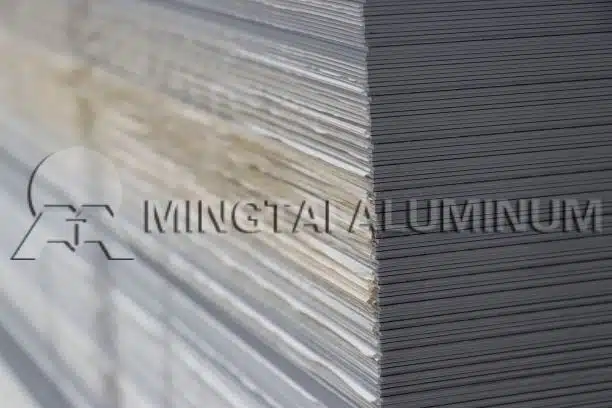
The 5×10 aluminum sheet from MINGTAI ALUMINUM remains a favorite across industries because of its mix of size, strength, manageable weight, and versatility. It’s large without being unmanageable, strong without being too heavy, and adaptable to everything from architectural facades to trailer manufacturing.
FAQ
Q: How much does a 5×10 aluminum sheet weigh?
A: It depends on thickness. As a quick reference: 0.063" ≈ 42 lbs, 0.125" ≈ 83 lbs, 0.250" ≈ 165 lbs.
Q: What are the most common alloys for 5×10 aluminum sheets?
A: 3003, 5052, and 6061 are the most frequently ordered for 5×10 aluminum sheets.
Q: Is 5×10 better than 4×8 for large projects?
A: Yes—fewer seams, fewer cuts, and a smoother appearance make 5×10 sheets ideal for large façade panels, signage, and trailer skins.