What Makes 5086 Aluminum Sheet a Preferred Choice for Marine Applications?
Why Is 5086 Aluminum Sheet Used Extensively in Marine Environments?
The 5086 aluminum sheet is a main material used in marine engineering. It has corrosion resistance to seawater and also has high mechanical properties. Magnesium content in this material increases strength while keeping ductility at a high level. 5086 aluminum sheet has higher strength than 5052 and 5083 aluminum sheet. This material gains strength by strain hardening or cold mechanical working, unlike heat treatment. This material maintains its structure after long-term exposure to seawater. Alloy 5086 has good resistance to pitting and crevice corrosion. These characteristics make 5086 aluminum sheet an ideal material to be used in parts that are in constant contact with seawater, such as hulls, decks, etc., and also for other offshore structures.
How Does the Composition of 5086 Aluminum Sheet Contribute to Its Performance?
The alloy performs well because of its chemical makeup. Magnesium is present at a level of 3.0% to 4.5%. This level of magnesium provides for good corrosion resistance and good weldability. Trace amounts of manganese and chromium are present in this alloy as well. These elements provide for mechanical strength and resistance to stress-corrosion cracking. The alloy is non-heat-treatable. It can be hardened by strain hardening. The alloy achieves its strength by forming a work hardening structure as it is formed by such processes as rolling, forging, or bending. After forming, the alloy can be welded without any loss of strength due to the lack of heat treatment. This approach to strengthening the alloy provides for consistent and predictable results after such processes as forming or welding.
Corrosion Resistance Properties of 5086 Aluminum Sheet in Marine Conditions
How Does 5086 Aluminum Sheet Resist Saltwater Corrosion?
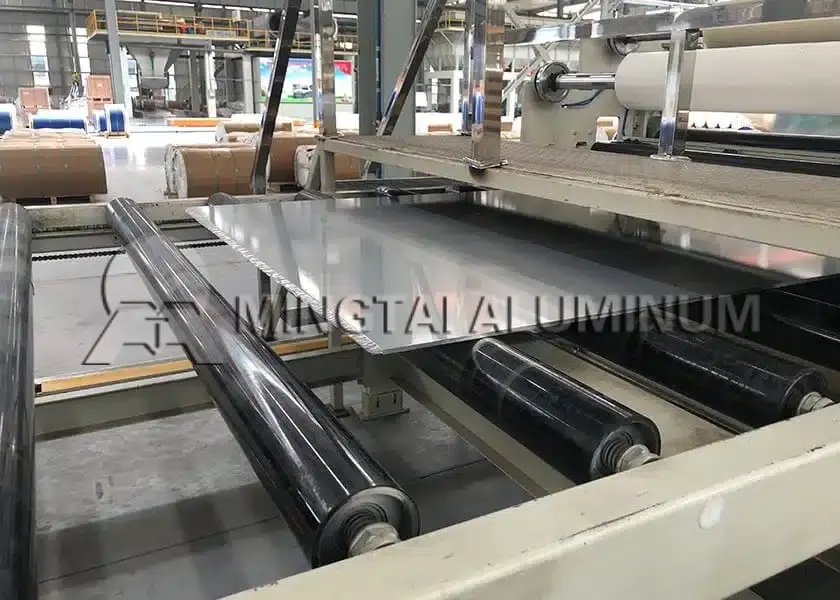
Corrosion control matters a great deal in marine work. The 5086 aluminum sheet forms a natural oxide layer on its surface. This layer protects against chloride ions in seawater. The film reduces pitting and crevice corrosion during long immersion. The alloy structure also limits galvanic reactions with other metals on ships or platforms. 5086 aluminum sheet fits uses that need high corrosion resistance, good weldability, and medium strength. Common examples include ships, cars, aircraft, cryogenic equipment, TV towers, drilling equipment, transportation equipment, missile parts, and decks. At our facilities at MINGTAI ALUMINUM, advanced rolling and finishing steps improve surface uniformity and strengthen this natural protection.
Factors Enhancing Long-Term Corrosion Resistance of 5086 Aluminum Sheet
We enhance the long-term corrosion resistance of 5086 aluminum sheets by applying anodizing or protective coatings, which help extend their service life in harsh marine environments. The alloy stability lowers the risk of long-term damage. Marine operators often see lower maintenance costs than with vessels made from 5052 or 6061. The mix of material stability and proper surface care supports reliable performance over many years at sea.
Mechanical Strength and Formability of 5086 Aluminum Sheet for Marine Structures
How Strong Is 5086 Aluminum Sheet Compared to Other Marine Alloys?
5086 aluminum sheet shows higher yield strength than 5052 or 5083 in common tempers such as H116 or H32. The alloy comes mainly in four tempers. These are 5086-H, 5086-H32, 5086-H112, and 5086-H116. These tempers deliver good fatigue resistance for hulls and decks that face repeated wave loads and vibration. Precision rolling at MINGTAI ALUMINUM creates a uniform grain structure across large panels. This uniformity supports predictable behavior during fabrication.
Formability and Weldability Advantages of 5086 Aluminum Sheet in Shipbuilding
The alloy forms complex curved hulls without cracking during bending. It accepts MIG and TIG welding with low risk of porosity or post-weld distortion. Post-weld strength stays high because heat treatment is not needed. This benefit proves useful in large welded assemblies such as bulkheads and superstructures.
Thermal Conductivity and Weight Efficiency of 5086 Aluminum Sheet in Marine Engineering
Why Is Lightweight Construction Important in Marine Design?
Lower vessel weight improves fuel efficiency and speed. It also supports better stability. The alloy's low density, combined with high tensile strength, allows lightweight builds without losing safety margins. MINGTAI ALUMINUM controls thickness precisely across different aluminum sheet thickness options. This control keeps quality steady, no matter which gauge selection, such as aluminum sheet metal gauge or aluminum gauge thickness standards, shipyards choose worldwide.
How Does the Thermal Conductivity of 5086 Aluminum Sheet Benefit Marine Equipment?
Good heat dissipation matters in engine rooms and on sun-exposed decks. The alloy holds dimensional stability during temperature swings. By combining the material’s mechanical reliability with effective heat transfer, Our production can deliver performance that stands up to demanding marine environments.
Applications of 5086 Aluminum Sheet in the Marine Industry by MINGTAI ALUMINUM
Common Marine Uses of 5086 Aluminum Sheet from MINGTAI ALUMINUM
MINGTAI ALUMINUM supplies marine-grade sheets for ship hulls, deck plates, gangways, storage tanks, and offshore platforms that face constant seawater spray. The same material also appears in automobiles, aircraft, pressure vessels, and refrigeration units. Fishing vessels use it for lightweight superstructures that improve fuel economy while keeping strength.
How Does MINGTAI ALUMINUM Ensure Quality Control in 5086 Aluminum Sheet Production?
We strictly monitor every stage of our production. Raw material checks continue until final temper verification. Surface treatments meet ASTM B928/B209 marine standards. Each batch receives full testing for dimensional accuracy before shipment. This process supports consistent aluminum sheet metal thickness tolerances required by international shipyards.
FAQ
Q: What makes the thickness of the aluminum sheet important when selecting a 5086 aluminum sheet for marine use?
A: Selecting an appropriate sheet aluminum thickness balances weight savings with load capacity. Thinner gauges improve flexibility. Thicker sheets add reinforcement against impact stress.
Q: How do 5083 vs 5086 alloys differ for shipbuilding applications?
A: Both alloys resist corrosion as well as Al-Mg series materials. 5086 offers slightly higher strain-hardened strength. This makes it preferable when added rigidity under cyclic loads is required.
Q: What factors influence 5086 aluminum sheet prices among different suppliers?
A: Market variables include raw magnesium cost changes, temper type, such as H32 or H116, and size details like aluminum gauge. Regional shipping also affects the total cost from global 5086 aluminum sheet suppliers.
Q: Can this alloy be used beyond the marine sectors, such as railway systems?
A: Yes. Its light weight and toughness suit aluminum alloy sheets for railway rolling stock. It works well in structural panels on modern aluminum alloy sheets for railcars where vibration fatigue resistance matters.
Q: Why does MINGTAI ALUMINUM emphasize precision control over aluminum gauge thickness during production?
A: Consistent control over aluminum gauges ensures uniform performance across large installations. This reduces variation in stiffness or weld response. The approach helps when fabricating extensive hull sections that need predictable material behavior under load.